

A Visual Music
Color System
See It. Play It. Hear It. Know It.
Then You'll Feel It, Live It & Share It!
Musical Colors® - A Visual Music Color System For Musical Instruments
Learn To Play Music Notes, Scales & Chords The Visual Way
Our eyes, fingers, hands, our brains, internal and muscle memories, all work together in unison, like a well-oiled machine with many moving parts, but all indispensable from one another. Whether your Instrument is set up to help you or not, you still have to physically put in the work and practice. When you do this, you begin to feel what it’s like to play notes, chords and scales, and where your hands and fingers need to be. Color helps with the initial steps in identification; however, your body soon takes over from there, and you are off on your own unique inner musical journey, without having to look outside anymore. When your eyes and hands learn together, your memory consolidates. Your sense of orientation strengthens. The more you learn visually and physically, the faster your internal memory and independence grows.
The Twelve Notes of Western Music - Color-Coded and Visualized
How Musical Colors® Arranges All Twelve Notes by Color
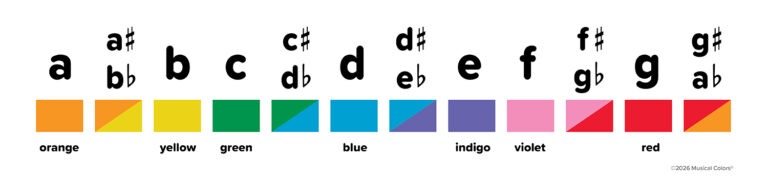
The system uses the seven (7) colors of the spectrum to correspond to the seven (7) natural notes found in today’s Western music (i.e. what we have termed the “solids”): The musical note C is Green, the musical note D is Blue, the musical note E is Indigo, the musical note F is Violet, the musical note G is Red, the musical note A is Orange, and the musical note B is Yellow. The five (5) sharp/flat Notes are mapped as pairs of their adjacent natural “solid” colors (i.e. what we have termed the “stripes”, a distinguishing feature): The musical note C#/Db is green/blue, the musical note D#/Eb is blue/indigo, the musical note F#/Gb is violet/red, the musical note G#/Ab is red/orange, and the musical note A#/Bb is orange/yellow. This creates a visual representation of the 12-tone note system, and it visually distinguishes the natural notes from the sharps/flats. Seven (7) white keys and five (5) black keys, Solids and Stripes. There are several ways to list the 12 notes in Western music, by where they are arranged along the natural color spectrum or also by what is termed their fixed serial numbers 1 (C) through 12 (B). Here they are arranged by alphabetical order:
START HERE IF YOU’RE JUST SETTING OFF ON YOUR MUSICAL JOURNEY NO MATTER YOUR AGE
By using Color, one can quickly see how the positions to play Musical Notes on Keyboards, Fretboards & Fingerboards, are logically laid out visually on a Musical Instrument
CLICK IF YOU’VE PROGRESSED ALREADY AND WANT TO LEARN MORE TO CRUSH YOUR LIMIT
It’s Simple to learn how Music is made, what it’s Composed of, and how to easily navigate musically to open up avenues for your own Creativity and Musical Development

ENTER HERE IF YOU’RE PROLIFIC NOW AND LOOKING FOR A DEEP DIVE REFRESHER
Color enables you to See, Play and Hear musical connections, and this Simple & Elegant Tool will help you Uncover further concepts that will Improve your overall Musicianship
TAP IF YOU’RE AN EDUCATOR OR PARENT LOOKING TO ENRICH YOUR CHILDREN’S LEARNING
Our Color Coded Learning System integrates seven natural spectrum colors using custom Sticker Guides placed directly on the playing surfaces of many Musical Instruments